
Air Cargo Logistics System
One screen for your team, one link for your customers: every import and export shipment from booking to delivery, and fewer “where is my cargo?” calls.
Aeronex is a concept air-cargo company. Its customers, airlines, flights and the six sample shipments are made up, and the airline API is deliberately not connected, so a status is whatever your team enters, never live flight data. Everything else works for real: you can create an account, add your own shipment, change its status, upload a document and then track it by AWB. On a real project the sample network is replaced with your company's own details, and nothing is shown that isn't true.
- My role
- design, development & database security
- Client
- Aeronex (concept air-cargo company)
- Year
- 2026
- Timeline
- About 1 month for this demo; a real project is scoped and timed before I start
Overview
The project in a nutshell
An air-cargo business lives on two questions: what needs my attention right now, and where is my customer's cargo? When the answers sit in spreadsheets, e-mail threads and phone calls, your team loses hours and your customers lose patience. I built Aeronex to show what the fix can look like for a freight forwarder or cargo agent. It is a complete, working system, not a mockup: open the live demo, filter the shipments, look up an AWB the way a customer would, then create your own shipment and watch it appear in public tracking. Every screen answers a question that someone at your company, or one of your customers, asks all day.
The challenge
A cargo team follows many shipments at once, each at a different stage, with different airlines, routes and customers. The status lives in someone's inbox, and the customer, who only wants to know whether the goods will arrive, has one way to find out: call or write to you. That costs your staff time, and it costs you trust, because a customer who has to chase you starts to wonder what else they aren't being told. And any tool that fixes this must never let one customer see another customer's shipments, prices or documents.
My solution
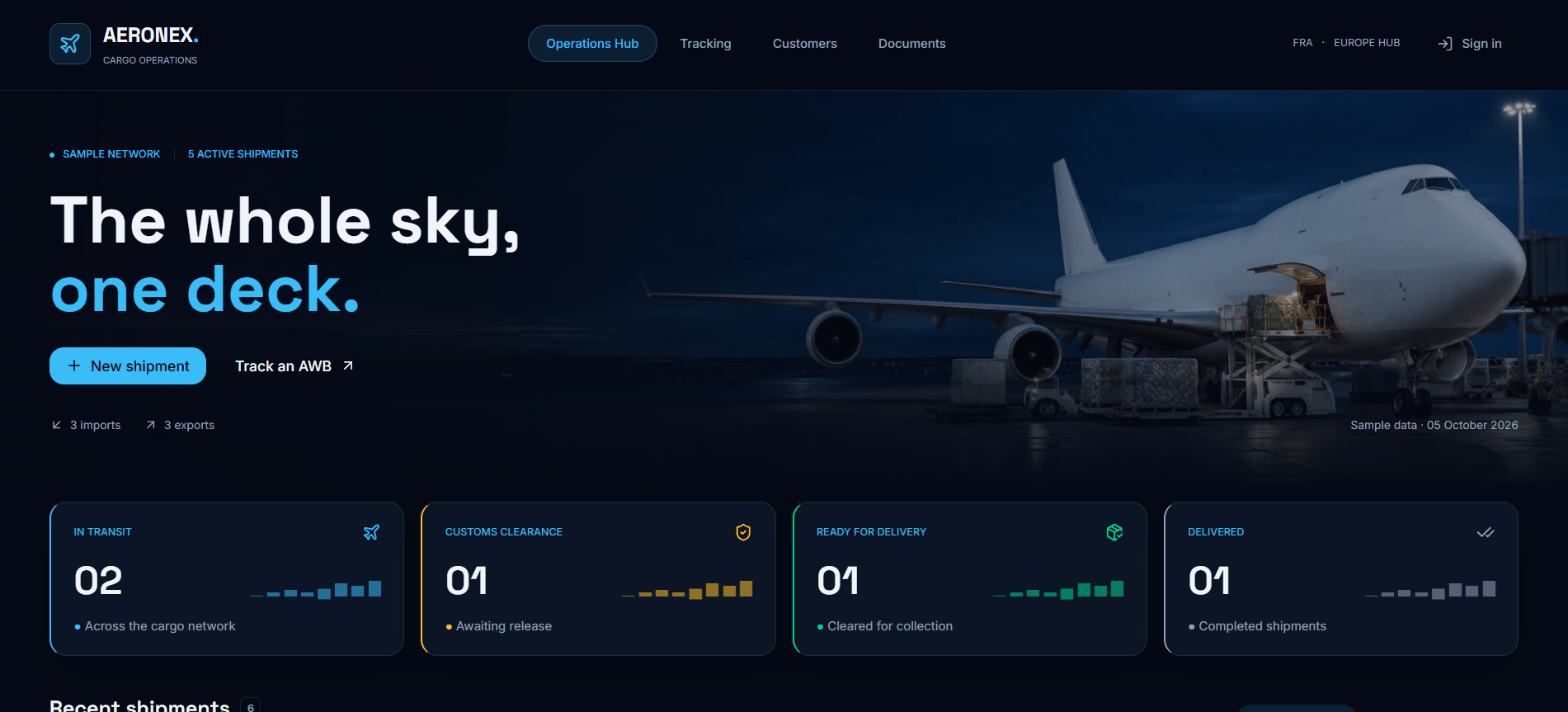
Two views on one source of truth. Inside, an operations hub shows what is in transit, in customs, ready for delivery and delivered, with a searchable shipment list. Outside, a tracking page where a customer types an AWB and sees the route, the flight and a dated history, and nothing else. Private data never reaches the public page: tracking reads from a separate table that holds only movement fields, and the database itself enforces who may see what.
What I built
Key features
See what needs attention first
Four status cards (In transit, Customs clearance, Ready for delivery, Delivered) count the shipments at each stage straight from your data, so your team knows where to look before opening a single record.
A shipment list you can really use
Search by AWB, customer, route or airline, filter Import or Export and by status, and export the current view to CSV for accounts or your customs broker. Each row shows AWB and route, customer, carrier and flight, status, departure and total charges. A customer directory groups the same shipments by company.
Tracking without a phone call
A customer enters an 11-digit air waybill number (formatted for them automatically) and sees the route, flight, pieces, weight, estimated arrival and a five-step line from Booked to Delivered, with every event dated underneath. No account, no password, no message to you.
Nine statuses, one honest history
Booked, Accepted, Departed, In Transit, Arrived, Customs Clearance, Ready for Delivery, Delivered and Cancelled. Every change your team saves adds a timestamped entry to the shipment's history, newest first, so you and your customer can always see what happened and when.
Private by design
Each account sees only its own shipments, and that rule is enforced by the database (row-level security), not just hidden in the interface. The public tracking page holds no customer names, charges or notes. Waybills, invoices and customs papers (PDF, images, Word, Excel, up to 10 MB) sit in private storage and open only through links that expire after a minute.
Built for people who watch it all day
A calm, dark, low-glare theme with clear status colors. Pages are rendered on the server, each with its own title and description for search engines, and animations switch off for visitors who prefer reduced motion. Every shipment is validated on the server before it is saved, and a duplicate AWB is refused.
The customer's path
From Google Maps to “I know where my cargo is”
This is what the system is designed around. Each step removes one reason for a shipper to pick up the phone, or to pick another forwarder.
- 01
They find you and tap “Website”
A company that needs air freight searches Google Maps for a cargo agent and opens your listing. The page they land on should feel like the same business they just saw on the map.
- 02
They check a shipment without asking
A customer with an AWB goes straight to Tracking. One field, one button, no account and no email to you.
- 03
They see exactly where the cargo is
Route, flight, five-step progress and a dated history, in plain words like Customs Clearance or Ready for Delivery instead of codes.
- 04
They see only what they should
Just the movement. Customer names, prices and documents never appear on the public page, so offering tracking costs you nothing in privacy.
- 05
Your team stays in control
The hub shows what needs attention, and every status your team saves is what the customer sees next. Fewer “any news?” calls, more time for the cargo.
Screens
Project gallery
Tap any image to view it full size.
On a real project
What your company would get
- Your real company name, branding, stations, airlines and routes in place of the sample network
- Your existing shipment list moved in from the spreadsheet or system you use today, so nobody retypes history
- A tracking page on your own domain that your Google Business Profile can link to, so a customer who finds you on Maps can check a shipment in one tap
- Your name, address, phone, hours and services written so search engines can read them, matching your Google Business Profile exactly
- Staff sign-in with access levels that fit how your team works: who can create, who can only view
- The public tracking fields agreed with you first, because it is your data and your customers
- Live airline data if your carriers give you API access; otherwise your team's updates drive the status, exactly as in the demo
- Full ownership of the source code and every asset, plus support after launch
Before you decide
Questions a cargo company usually asks
Will this put my company at the top of Google Maps?
No website can promise that, and I won't either. Your Maps ranking mostly depends on your Business Profile: category, reviews, activity and how close the customer is. What this system does is give the shippers who already find you a reason to trust you and a self-service way to check their cargo, and keep your name, address and hours consistent everywhere Google looks. If anyone guarantees you the first position, be careful.
Is anything in this demo real?
The software is real and fully working. The company is not. Its customers, airlines, flights and the six shipments are made up, and the page says so. The airline API is deliberately not connected, so a status is only what a person types in, and I never present sample data as live tracking. You can create your own account and shipment and see exactly how it behaves.
Can my customers see each other's shipments or prices?
No. Anyone who has an AWB number can see that shipment's movement, the same way airline tracking works, but there is no list to browse and the public view never contains customer names, charges, notes or documents. Signed-in users see only their own shipments, and the database enforces that, not only the interface.
Does it connect to airline systems?
Not in the demo. On a real project it depends on what your carriers offer you. If they give you API or data-feed access, I'll tell you what is realistic to connect. If they don't, your team's updates drive the status, each one timestamped. You will hear this in the first conversation, before you pay for anything.
We already use spreadsheets or another system. Do we have to throw it away?
No. We can start with the part that hurts most, usually customer tracking and one clear view of open shipments, and move your existing data in. If your current system can export data or has an API, we can connect to it instead of replacing it.
I'm not technical. Who looks after it, and who owns it?
You own it. On delivery the source code and all project assets are yours. Day-to-day changes are small edits, and if you would rather not touch anything, send me the change and I'll make it. I stay available after launch.
What happens first, and how do I know what I'm paying for?
We start with a short conversation about how your shipments move today. You then get a clear scope, timeline and price before I write any code, and a working preview early, so you can react to something real. I built this demo in about a month, and a real project depends on how much of the list above you need. You only move forward if you like what you see.
Run an air-cargo or freight business?
Send me the link to your Google Maps listing or your current website. I'll look at what a customer sees after tapping it and how they check on a shipment today, and tell you what I would change, honestly and with no pressure.
© 2026 Ali Afarinifard. All rights reserved.